 On paper, a 154-pound weight savings and a 10-hp increase in power are not exactly the stuff dreams are made of. The truth is, the benefits of the new Lamborghini Gallardo Superleggera's high-carbon-fiber, low-calorie diet are not immediately obvious, especially given the nearly 20 percent surcharge over the $181,500 base Gallardo. And unlike the new Porsche 911 GT3 RS, the 2999-pound Superleggera (superlight) has no competition aspirations. That's a shame, because this car really needs a racetrack to fully deploy its potential. With the exception of the 0.2 second by which it improves in 0-to-62-mph acceleration (3.8 versus 4.0 seconds, according to the factory), it's at the edge of grip and adhesion where the lightweight Lambo shines brightest.
On the road, the cream-of-the-crop Gallardo is nothing more than a noisier and louder version of the mid-engine coupe that already scores ten out of ten points on the street-credibility scale. On the track, however, the Superleggera sifts the men from the boys by giving more and asking for more. More risk and more trust. Later braking and even later downshifts. A make-it or break-it line that straddles curbs, advances turn-in points, and uses all the clean tarmac there is. It's not just the mind-boggling velocity that makes your neck hair stand on end between gearshifts. It's also the car's fluidity, its balance, and the way it laughs at fourth-gear sweepers that enchants you. A GT3 RS might be more nimble and chuckable, but the Lambo is certainly in the same performance league. While it's more composed and controllable overall than the 911, the lightweight Gallardo is no less challenging, especially when the stability control is turned off.The Superleggera's lack of all but the most basic sound-deadening materials makes the journey to the limit as stimulating to your ears as it is taxing to your firmly strapped-in body. Thanks to four-wheel drive, launches will never be as overtly spectacular as they are in a powerful rear-wheel-drive car, but the sensation of excess traction is no less exciting to a keen driver than a pair of smoking tires. Since the needle of the rev counter shoots up the orange-on-gray dial like a rocket, your right index finger must always be on the alert, ready to blip the paddleshifter to call up the next gear ratio.
The 5.0-liter V-10 is untouched except for a reprogrammed ECU and a lighter exhaust with reduced back pressure. It sounds two octaves more Jack the Ripper-esque than the base Gallardo, but the gain in grunt is more acoustic than it is tangible. What makes all the difference is the optional paddleshift E-gear's transmission management. Downshifts are still prompt, but full-throttle upshifts are superaggressive.
The transition from first to second gear feels like a sudden in-cab explosion. Second to third is almost as quick and mechanical. From third to fourth, the driveline at last seems to come to terms with the high revs, the big oomph, and the serious power. At all engine speeds, the throttle response mixes telepathy with anticipation. Above 5000 rpm in particular, it feels as if your right foot is minutely and directly modulating the intake flow. A conventional six-speed manual transmission also is offered.
The sportier dampers are a welcome modification on the track, where poise, roadholding, and control are instrumental for shaving off tenths of a second. On fresh tires, the Superleggera must be pure bliss, but driving on our test car's taxed nineteen-inch Pirellis, the Lambo was flat and amazingly stable. Despite the tail-friendly 30/70 percent torque split, you experience the full handling spectrum, from determined understeer to radical oversteer, and, even with the stability control engaged, the Lambo permits dramatic drift angles. All-wheel drive notwithstanding, the steering offers good feel. It's on the heavy side, even by supercar standards, but it is very accurate.
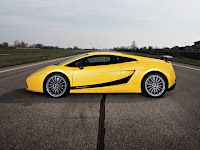
The only gripe one might have with the Superleggera's livery is the full-length decal that looks a bit aftermarket. The mirror housings and the $5850 rear wing are made of carbon fiber. Inside, black Alcantara stretches from wall to wall, and the fit and finish are world-class. The same applies to the carbon-fiber bucket seats, which are shaped to perfection but aren't available in the States, because U.S. cars get seats with side air bags. To further save weight, Lamborghini applied carbon fiber to the door panels and the center console and made the radio and navigation system optional. Also, the rear window and the rear side windows are now made of polycarbonate, not glass.
The V-10-pow

ered Lamborghini has matured tremendously since it was first released in 2003, but it's worth remembering that our impressions were restricted to the track. The Superleggera starts to shine only at a pace where most drivers have long since backed off, and the $33,500 price premium doesn't include the carbon-ceramic brakes, which cost an additional $15,000. I gave back la bella macchina reluctantly, grinning from ear to ear, but if it were my own money, I'd opt for the Gallardo Spyder. Call me a wimp, but I'm afraid that's what getting older does to you.

 On paper, a 154-pound weight savings and a 10-hp increase in power are not exactly the stuff dreams are made of. The truth is, the benefits of the new Lamborghini Gallardo Superleggera's high-carbon-fiber, low-calorie diet are not immediately obvious, especially given the nearly 20 percent surcharge over the $181,500 base Gallardo. And unlike the new Porsche 911 GT3 RS, the 2999-pound Superleggera (superlight) has no competition aspirations. That's a shame, because this car really needs a racetrack to fully deploy its potential. With the exception of the 0.2 second by which it improves in 0-to-62-mph acceleration (3.8 versus 4.0 seconds, according to the factory), it's at the edge of grip and adhesion where the lightweight Lambo shines brightest.
 ered Lamborghini has matured tremendously since it was first released in 2003, but it's worth remembering that our impressions were restricted to the track. The Superleggera starts to shine only at a pace where most drivers have long since backed off, and the $33,500 price premium doesn't include the carbon-ceramic brakes, which cost an additional $15,000. I gave back la bella macchina reluctantly, grinning from ear to ear, but if it were my own money, I'd opt for the Gallardo Spyder. Call me a wimp, but I'm afraid that's what getting older does to you.


